How Enterprise AI Governance Differs from Managed Agent Infrastructure
09 April 2026
Executive Summary
On April 8, 2026, Anthropic launched Claude Managed Agents — a cloud-hosted platform that lets developers build, deploy, and run autonomous AI agents on Anthropic's infrastructure. It's a significant product: sandboxed execution, session management, MCP tool integration, and credential vaulting, all abstracted behind an API. For teams building Claude-native agents, it removes months of infrastructure work.
But Claude Managed Agents is not a governance platform. It is agent infrastructure. It runs your agents. It does not govern them.
ContextGate occupies a fundamentally different position in the AI stack. Where Anthropic provides the rails for agents to run on, ContextGate provides the guardrails for what those agents are allowed to do, which data they can access, and how their outputs are validated before reaching production systems. These are complementary layers, not competing ones — and understanding the distinction is critical for any enterprise evaluating its AI agent strategy.
This article provides a detailed, feature-by-feature comparison of both platforms, identifies what ContextGate provides that Claude Managed Agents does not, and explains why enterprises operating in regulated industries need both layers in their AI stack.
1. What Claude Managed Agents Is
Claude Managed Agents is a fully managed runtime for Claude-powered autonomous agents. Anthropic describes it as providing "the harness and infrastructure for running Claude as an autonomous agent." Instead of building your own agent loop, tool execution, and runtime, you get a managed environment where Claude can read files, run commands, browse the web, and execute code securely.
Core Architecture
The system is built on three decoupled, virtualized components, as detailed in Anthropic's engineering blog:
- Session: An append-only log of everything that happened during an agent's execution. This serves as a durable context object outside Claude's context window, enabling recovery after failures and persistent event history.
- Harness: The stateless orchestration loop that calls Claude and routes Claude's tool calls to the appropriate execution environment. Harness instances scale independently and can be swapped without affecting other components.
- Sandbox: An isolated execution environment where Claude can run code and edit files. Containers are treated as disposable — if one fails, the harness catches the error and provisions a replacement.
Key Features
- Managed hosting and scaling: Agents run on Anthropic's infrastructure with automatic scaling. No need to manage containers, orchestration, or deployment pipelines.
- Built-in tool support: Bash execution, file operations (read, write, edit, glob, grep), web search and fetch, and MCP server integration for external tools.
- Credential vaulting: OAuth tokens are stored in a secure vault. Claude calls MCP tools via a dedicated proxy that fetches credentials without exposing them to the sandbox or the agent's generated code.
- Session persistence: Event history is persisted server-side. Sessions can be resumed, steered mid-execution, or interrupted to change direction.
- Checkpointing and recovery: Failed containers become routine errors rather than catastrophic failures. The harness recovers state and re-provisions execution environments.
- Prompt caching and compaction: Built-in performance optimizations for efficient, high-quality agent outputs over long-running sessions.
- Multi-agent coordination: Currently in research preview, allowing multiple Claude agents to coordinate on complex tasks.
Pricing
Customers pay standard Claude API token pricing plus $0.08 per session-hour for active runtime (measured in milliseconds). Web search incurs an additional $10 per 1,000 searches.
What It Is Not
Claude Managed Agents is explicitly not a governance layer. It does not provide policy enforcement on agent outputs, PII redaction, per-tool authorization rules, regulatory compliance frameworks, model-agnostic orchestration, or output validation beyond Claude's built-in safety measures. It is infrastructure for running Claude agents, not a security gateway for controlling what those agents do.
2. What ContextGate Is
ContextGate is an enterprise-grade AI governance platform that sits between AI agents (regardless of which model powers them) and the external services those agents interact with. It functions as a security gateway: every tool call, every piece of data flowing in or out of an agent, passes through ContextGate's policy engine before reaching its destination.
Where Claude Managed Agents answers "how do I run my AI agent?", ContextGate answers "how do I ensure my AI agent follows our rules?"
Core Architecture
- LLM Proxy with PII Redaction: All traffic between agents and LLMs passes through ContextGate's proxy layer, which can detect and redact personally identifiable information before it reaches the model or external services.
- MCP Tool Gateway with Per-Tool Authorization: Rather than giving agents blanket access to all connected tools, ContextGate enforces granular, per-tool authorization rules. An agent might have read access to Google Docs but not write access, or access to certain folders but not others.
- Policy Engine (Dual-Layer): Hard guardrails via regex pattern matching execute in under 1ms. Soft guardrails via LLM-based evaluation execute in under 500ms. This dual approach balances speed with nuance — simple rules fire instantly, while complex policy evaluations still resolve in sub-second timeframes.
- Model-Agnostic Design: ContextGate governs agents regardless of the underlying model — Claude, GPT-4, Gemini, Llama, Mistral, or any other. The governance layer is decoupled from the inference layer.
- Workspace Isolation: Each workspace operates in complete isolation with its own agents, connections, policies, and audit trails. This is fundamental for enterprise multi-tenancy.
- RBAC (Role-Based Access Control): Four-tier permission model (Owner, Admin, Member, Viewer) with LDAP, SAML, and OAuth integration for enterprise identity management.
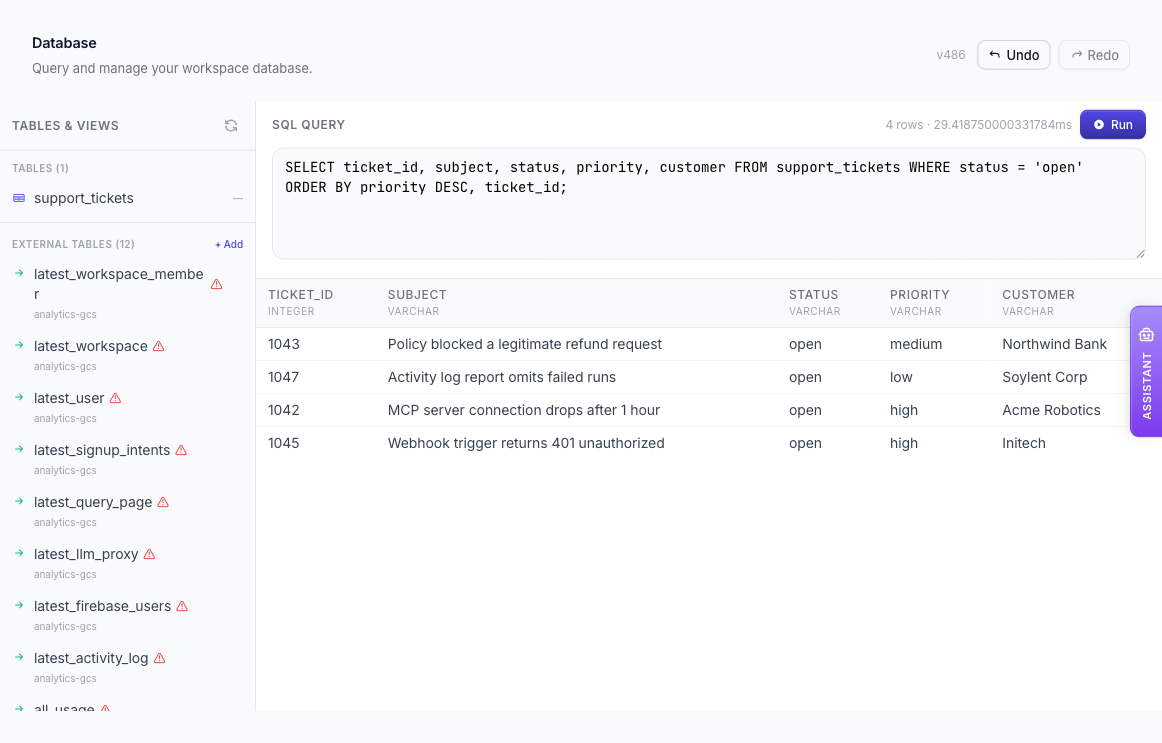
- Universal SQL Engine: Natural language to SQL with governance guardrails, powered by DuckDB, allowing agents to query structured data while respecting access controls.
Additional Platform Features
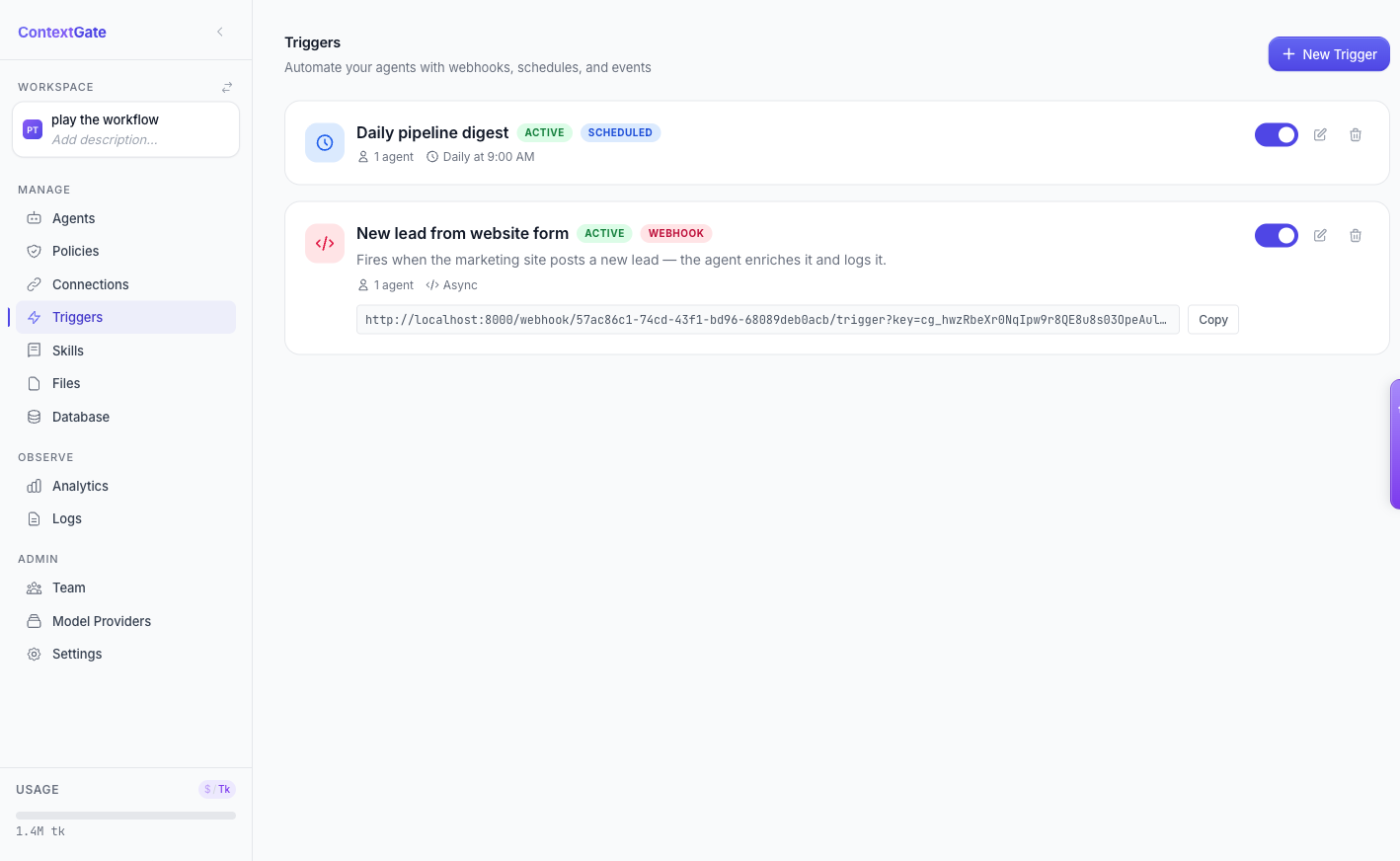
- Triggers System: Webhook, scheduled, and event-driven triggers with Composio integration for connecting to external services and automating agent workflows.
- Agent Instructions Editor: In-platform system prompt authoring and management for governed agents.
- Billing and Usage Metering: Token-level tracking with model tiers, giving enterprises visibility into AI spend per agent, per workspace, per user.
- Azure APIM AI Gateway: Rate limiting and API management through Azure's enterprise gateway for production deployments.
- Audit Logging: Every agent action, tool call, policy evaluation, and data access event is logged for compliance and forensic analysis.
- Output Policy Checks: Agent outputs are evaluated against configurable policies before being delivered, with violations flagged or blocked.
3. Feature-by-Feature Comparison
The following table provides a direct comparison of capabilities across both platforms. Note that many of these features are not in competition — they address different layers of the AI agent stack.
| Capability | Claude Managed Agents | ContextGate |
|---|---|---|
| Model Support | Claude models only (Opus, Sonnet, Haiku) | Model-agnostic: Claude, GPT-4, Gemini, Llama, Mistral, and any OpenAI-compatible endpoint |
| Agent Runtime | Fully managed cloud containers with auto-scaling | Not an agent runtime — governs agents running on any infrastructure |
| Tool Execution | Built-in bash, file ops, web search, MCP servers | MCP Tool Gateway with per-tool authorization and policy enforcement on tool calls |
| Policy Engine | No dedicated policy engine. Relies on Claude's built-in safety + system prompts | Dual-layer: regex hard guardrails (<1ms) + LLM soft guardrails (<500ms). Configurable per agent |
| PII Redaction | Not provided as a platform feature | Built-in PII detection and redaction on all data flowing through the proxy |
| Output Validation | No output policy checks beyond model safety | Configurable output policy checks with violation detection and blocking |
| Per-Tool Auth | Scoped permissions at agent level | Granular per-tool, per-action authorization rules (e.g., read but not write on specific tools) |
| Audit Trail | Session event logs and execution tracing | Comprehensive audit logging of every action, tool call, policy evaluation, and data access |
| Multi-Tenancy | Organization-level API keys | Workspace isolation with independent agents, connections, policies, and audit trails per tenant |
| RBAC | API key-based access | Four-tier RBAC (Owner/Admin/Member/Viewer) with LDAP/SAML/OAuth integration |
| Credential Mgmt | OAuth vault with proxy-based isolation from sandbox | Fernet encryption for credentials with workspace-scoped access |
| Session Mgmt | Persistent sessions with event history, checkpointing, and recovery | Not applicable — ContextGate is a gateway, not a session manager |
| Code Execution | Sandboxed containers with pre-installed packages | Not applicable — ContextGate governs tool calls, not code execution |
| Compliance | Compliance API for admin audit logs (launched March 2026) | Built-in compliance frameworks for ISO standards, medical regulations, financial regulations |
| Data Governance | Standard Anthropic data handling policies | Enterprise data governance: PII redaction, data residency controls, workspace isolation |
| Token Tracking | Standard API usage metrics | Per-agent, per-workspace, per-user token metering with model tier tracking and billing |
| Triggers | API-driven session creation | Webhook, scheduled, and event-driven triggers with Composio integration |
| Deployment | Anthropic's cloud (managed) | Self-hosted (Docker/K8s), GCP Cloud Run, or hybrid. Customer controls data residency |
4. What ContextGate Provides That Claude Managed Agents Does Not
While the comparison table shows the full picture, several categories of capability represent fundamental gaps in Claude Managed Agents from an enterprise governance perspective. These are not features Anthropic chose to omit — they are outside the scope of what Managed Agents is designed to do.
4.1 Model Agnosticism
This is the most consequential architectural difference. Claude Managed Agents runs Claude. Only Claude. If your enterprise uses Gemini for certain tasks, GPT-4 for others, and a fine-tuned Llama model for domain-specific work, Managed Agents cannot govern any of that.
ContextGate's governance layer is completely decoupled from the inference layer. It governs the boundary between any agent and any external service, regardless of which model powers the agent. For enterprises with multi-model strategies (which, according to industry surveys, is the majority of enterprises deploying AI in production), this is not optional — it's foundational.
This is particularly relevant as the model landscape evolves rapidly. An enterprise that locks its governance into a single vendor's agent platform cannot easily adapt when a better model emerges for a specific use case, or when regulatory requirements mandate the use of a particular provider for certain data categories.
4.2 Dedicated Policy Engine
Claude Managed Agents relies on Claude's built-in safety measures and system prompt instructions for guardrails. While Claude's safety is industry-leading at the model level, this is fundamentally different from a dedicated, configurable policy engine that enforces enterprise-specific rules.
Consider a clinical trials operation where agents must never include patient identifiers in documents sent to external reviewers, or a financial services firm where agents must not reference specific client account numbers in generated reports. These are not general safety concerns that a model's training would catch — they are domain-specific, organization-specific rules that require a dedicated enforcement layer.
ContextGate's dual-layer policy engine provides this. Hard guardrails (regex patterns) catch known violations in under 1ms with zero false negatives. Soft guardrails (LLM evaluation) handle nuanced policy questions in under 500ms. The combination provides both speed and judgment, and the rules are configurable per agent, per workspace, without retraining or fine-tuning any model.
4.3 PII Redaction as a Platform Feature
Claude Managed Agents does not provide PII redaction at the platform level. If an agent accesses a Google Doc containing patient records, processes the data, and generates a summary, there is no built-in mechanism to ensure personally identifiable information is stripped before it reaches the model or before the output is delivered.
ContextGate's LLM Proxy intercepts all traffic between agents and external services. PII detection and redaction is applied automatically, before data reaches the model and before outputs reach external systems. For healthcare, financial services, and legal operations, this is a regulatory requirement, not a nice-to-have.
4.4 Output Policy Checks
When a Claude Managed Agent completes a task and produces output, that output is delivered as-is. Anthropic's built-in content safety applies, but there is no enterprise-configurable layer that evaluates whether the output meets organizational standards, regulatory requirements, or domain-specific quality criteria.
ContextGate evaluates every agent output against configurable policies before delivery. If an agent generates a document that violates a compliance rule, contains unauthorized information, or fails a quality check, ContextGate can flag it, block it, or route it for human review. This is the difference between "the model didn't say anything harmful" and "the output meets our specific regulatory and quality standards."
4.5 Deployment Sovereignty
Claude Managed Agents runs on Anthropic's cloud. Full stop. Your agents, your data, and your execution happen on infrastructure you do not control. For many use cases, this is perfectly acceptable. For regulated industries with data residency requirements, it may not be.
ContextGate can be self-hosted via Docker Compose or Kubernetes, deployed to GCP Cloud Run, or run in hybrid configurations. The enterprise controls where its governance layer runs, where its audit logs are stored, and where sensitive data is processed. This is a hard requirement for many healthcare, government, and financial services organizations.
4.6 Granular Tool Authorization
Claude Managed Agents provides scoped permissions at the agent level. You define which tools an agent can access when you create it. But the granularity stops there — an agent either has access to a tool or it doesn't.
ContextGate's MCP Tool Gateway provides per-tool, per-action authorization. An agent might be authorized to read documents from Google Drive but not create or delete them. It might be authorized to search Gmail but not send emails. It might have access to certain folders but not others. This fine-grained control is essential in enterprise environments where the principle of least privilege must be enforced at the tool-action level, not just the tool level.
4.7 Comprehensive Token Economics
Claude Managed Agents bills standard API token pricing plus a per-session-hour fee. This gives basic cost visibility, but it doesn't provide the granular breakdown enterprises need to allocate AI costs across business units, track spend per agent, or optimize token usage across different model tiers.
ContextGate provides per-agent, per-workspace, per-user token metering with model tier tracking. This allows enterprises to understand exactly where their AI budget is going, implement chargeback models for internal teams, and make data-driven decisions about which agents justify their cost.
4.8 Regulatory Compliance Frameworks
Anthropic launched a Compliance API in March 2026 that provides structured audit logs of admin and resource activity. However, the prompts and completions themselves — the actual content of model interactions — remain outside the scope of that feed. This means the Compliance API tracks who created what resource, but not what the agents actually said or did.
ContextGate provides built-in compliance frameworks for ISO standards, medical regulations (relevant to clinical trials and healthcare operations), and financial regulations. Every agent interaction — including the content of tool calls, the data accessed, and the outputs generated — is captured in the audit trail. For industries where regulators require evidence of what an AI system did and why, this level of traceability is mandatory.
5. Complementary, Not Competitive
The most important takeaway from this analysis is that Claude Managed Agents and ContextGate are not competing products. They address different layers of the enterprise AI stack, and the most robust deployments will use both.
Consider the following architecture for a regulated enterprise deploying AI agents:
- Infrastructure layer: Claude Managed Agents (or equivalent) provides the runtime — sandboxed execution, session management, tool routing, and scaling.
- Governance layer: ContextGate sits at the boundary, enforcing policies on every tool call, redacting PII, validating outputs, and maintaining the audit trail.
- Model layer: Claude, GPT-4, Gemini, or any model appropriate for the task, selected based on capability, cost, and regulatory requirements.
In this architecture, Claude Managed Agents handles the "how does this agent run?" question. ContextGate handles the "what is this agent allowed to do?" question. Neither replaces the other.
For enterprises already evaluating Claude Managed Agents, the question is not whether to use ContextGate instead, but whether to add ContextGate as the governance layer that Managed Agents deliberately does not provide. For organizations operating in healthcare, finance, legal, or any regulated vertical, the answer is almost certainly yes.
6. Conclusion
Claude Managed Agents is an impressive piece of infrastructure. It solves real problems around agent deployment, scaling, and execution. For development teams building Claude-native agents, it removes significant operational burden. Anthropic's engineering is first-class, and the platform will only improve.
But infrastructure is not governance. Running an agent securely is not the same as governing what that agent does. The distinction matters most in exactly the environments where AI agents have the highest stakes: healthcare operations processing patient data, financial services handling client information, legal workflows touching privileged documents, and clinical trials managing regulatory submissions.
ContextGate provides the governance layer that enterprises in these verticals require: model-agnostic policy enforcement, PII redaction, per-tool authorization, output validation, compliance-grade audit trails, and deployment sovereignty. These capabilities exist independently of which agent runtime an enterprise chooses, and they apply regardless of which model powers the agents.
The future of enterprise AI is not a choice between infrastructure and governance. It is both. Claude Managed Agents builds the highway. ContextGate provides the traffic laws, speed cameras, and safety barriers. Enterprises need both to move fast without crashing.
ContextGate is an enterprise AI governance platform that provides a security gateway between AI agents and external services. Founded in 2025, the company is part of the AI Forge incubator programme and is backed by a Microsoft partnership. For more information, visit contextgate.ai.